
Video tutorial: how to install an anchor.
The operation is a delicate one, dealing with a joint that cannot afford to fail. However, it is undoubtedly a task that falls within the scope of DIY, especially for those who want to discover every corner of their boat more closely. But how to install an anchor safely, easily, and quickly? The answer comes from the Permanent Test Center of Boat Review Magazine, inaugurated last autumn at Marina Porto Antico. Here, on a sunny quay of the picturesque Marina Porto Antico in Genoa, we illustrate step by step how to replace a boat’s anchor.
The protagonist of our tutorial – which is also available on our YouTube channel – is the innovative Olympic anchor by Quick, a brand that, given the many tests scheduled at our Test Center, boasts a dedicated position right inside Marina Porto Antico.
How to install an anchor: preparations for replacement
Installing an anchor – even a rather heavy model – should not involve effort, waste of time or difficulty. It’s all about tackling each step the right way. Firstly, it is good to ensure the best of work areas, taking care to moor your boat bow-to. By doing so, you will find yourself face to face with the bow roller, keeping your feet firmly planted on the quay.
By operating the windlass remote control, you can place the anchor directly on the ground, to proceed with the replacement of this heavy nautical accessory without performing exhausting acrobatics and without even getting your hands wet. In a situation like this, it is easy to proceed with the disassembly of the old anchor, freeing the chain.
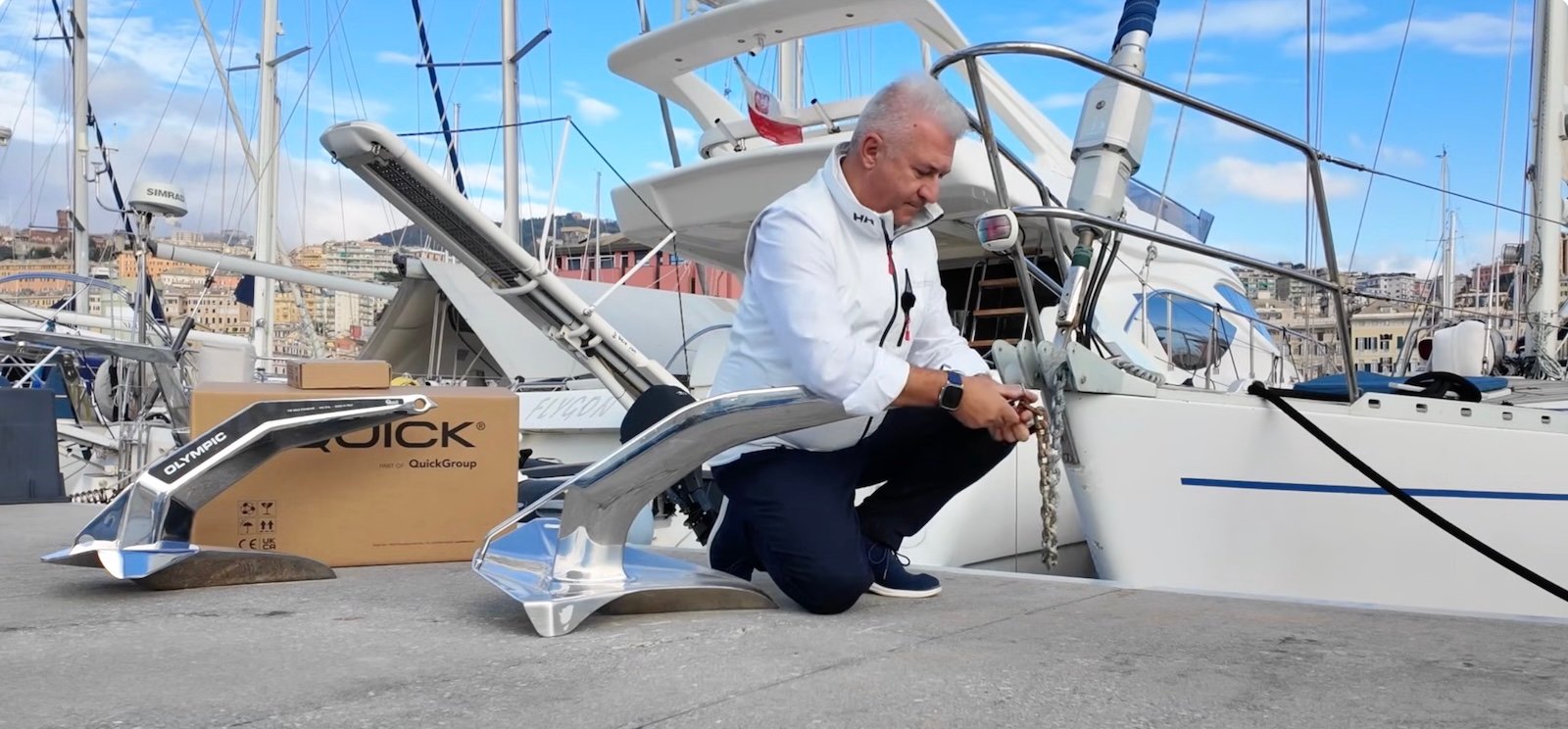
This could also be an excellent opportunity to check the health of the final section of the anchor chain, which is the most exposed. In our case, the first 20 centimeters showed significant wear, a consequence of three years of use. Fortunately, a problem of this type can be eliminated quickly and without regrets: we therefore took advantage of the circumstance to cut the chain, simply using a good bolt cutter.
How to install an anchor simply and quickly
As is well known, a good joint between anchor and chain is not limited to guaranteeing resistance to jolts: the best connector is the one that allows for the best management of the anchor’s movements when lowering and raising. It is no coincidence that, instead of classic shackles and swivels, the use of specially made joints is now preferred.
In the case of the Olympic series anchors, Quick has developed a special swivel joint in Duplex steel (which boasts superior mechanical resistance to AISI 316 steel). Solid, rotating and polished, it is characterized by fluid movements and tightenings that guarantee peaceful nights at anchorage.
The use of the joint is quite intuitive, knowing that the longer, cylindrical part will be used to fix the anchor, while the smaller, conical one must be used to connect to the chain. We start precisely by positioning the last link of the chain in the upper seat of the joint, then inserting the pin and fixing it by tightening the two specific grub screws (the correct size Allen key is included in the Quick supply).
The extra care, for each grub screw to be tightened with the Allen key, is to ensure the fixing with some threadlocker liquid, so as to further reduce the possibilities – already low in themselves – of accidental unscrewing.
The new anchor can now be installed by removing the lower pin from the joint. This is characterized by a rotating pawl, which must be positioned in the eye of the anchor to eliminate all friction. Once the joint is in position, the pin re-inserted and the relative grub screws tightened, the job can be considered finished.
Now there is nothing left to do but return the anchor to its rest position, again with the help of the windlass. In the video, we show how, using a small line, it is possible to move the anchor from the quay in complete safety.
The Olympic anchor by Quick: clever even on the quay
Filming this tutorial on how to install an anchor, we had the opportunity to see firsthand the quality of the new generation Olympic anchors: the simple fact of having completed everything in a few minutes is in itself a sign of excellent engineering.
The most recent of the Quick anchor series offers models from 7 kilograms to 140 kilograms, to safely equip yachts up to 34 meters in length. To have another point of reference, the Olympic model suggested for boats between 9 and 12 meters in length is the 10-kilogram one.
Among the features appreciable even on the quay are certainly the intelligent mechanisms of the swivel joint patented by Quick. What positively surprised us was above all the self-righting system, which significantly makes life easier for boaters: thanks to the design of the ball joint and the particular position of the eyelet, in fact, the anchor manages to automatically position itself correctly when pulled back onto the bow roller.
These anchors have much more to tell, however, knowing that Quick’s technicians have worked long and hard to move the center of gravity towards the end and to concentrate the weight on the front part of the fluke, so as to guarantee the best possible hold. To put these innovations to the test, in the coming months the Olympic anchors on display at the port of Genoa will be the protagonists of decidedly tougher and more challenging tests: here at the permanent Test Center of The International Yachting Media, we can’t wait to try the new dynamometer to test Quick products!
Other scheduled tests
Not just Quick: in recent months our Test Center has been carrying out other interesting tests, starting for example from the one designed to measure the durability and effectiveness of the Sibelius Light Endurance antifouling by Stoppani, or the durability test to test the resistance of the Selva Black Bass 8 outboard (the test started last summer, with the tender and engine combo already exceeding 1,000 nautical miles).
We will therefore return in the coming weeks with the results of these tests and, obviously, with new interesting educational lessons. How to install an anchor correctly is in fact only the first of the questions we will answer from the quays of Marina Porto Antico in Genoa!