
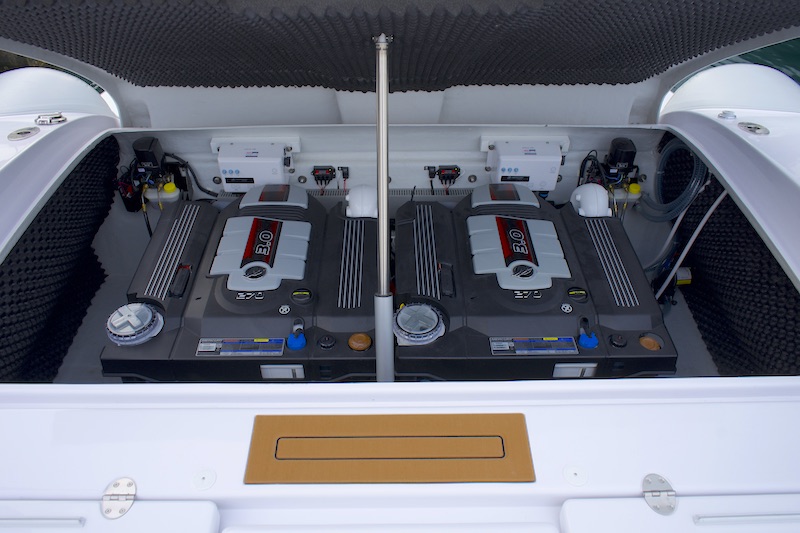
If, when thinking about diesel inboard engines, your memory made you recall pictures of heavy bulky motors, now you must reset all standards because Mercury Marine has introduced a new innovative product. With a weight of just 348 kg ( 358 in the sterndrive version), the new Mercury Diesel 3.0 L is lightweight, compact and features an extraordinary power-to-weight ratio: 0.75 horsepower/kg.
Noteworthy is the design effort in reducing encumbrance: less than 85 centimeters per side and 81 centimeters of height provide the new cylinder block with easy accommodation, facilitating even the most difficult installations.
In short, we’re talking of an engine destined to make the news. It is no coincidence that we have tested it in advance at Genoa International Boat Show in the element which it has been created for : the sea.
How the new Mercury Diesel 3.0 L is made
 The new Mercury 3.0 L is a V-6 common-rail engine that, equipped with a turbocharger, is available in both 230hp and 270hp variants. The latter is the version we tested.
Designed to deliver high torque at low rpms, it requires low maintenance. With an oil capacity of 8.5 liters and an oil maintenance interval of 200 hours ( or annually), it requires very low running costs.
Moreover, the engine design simplifies maintenance by locating service points at the front of the engine. The oil, coolant, fuse box, seawater strainer, drive lube and power steering fluid service points are all located at the front of the engine in order to provide easy-to-understand service guidelines and easy-to-reach access.
The saving of weight 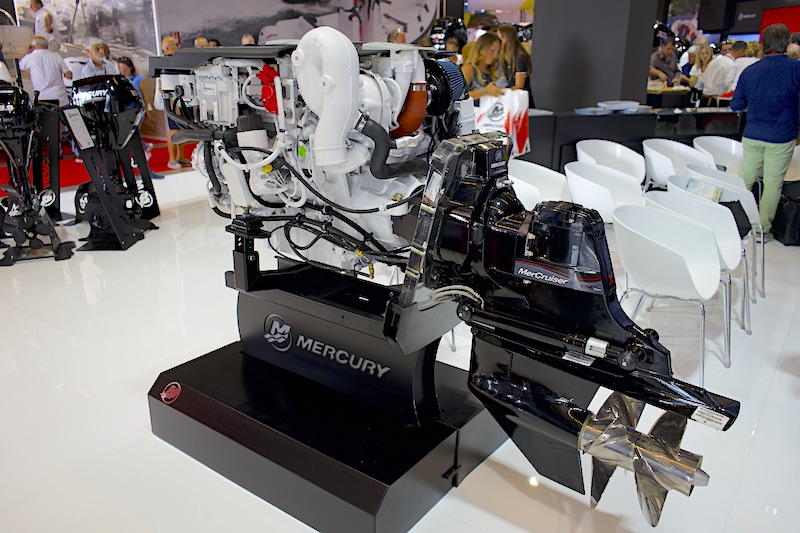 compared to other diesel engines of equal power is significant – almost 200 kg per engine – and results into better trim for the boat that mounts this type of engines. The boat, in fact, will benefit from a more neutral and less stern-trimmed balance combined with greater comfort and lower friction at sea ( lower use of trims/flaps).
The framework of the improvements introduced by the new Mercury Diesel 3.0 L is completed by a very low noise and vibration level, which represents an additional important aspect.
Now, it’s time to see at sea whether and how all the results we have just listed have been achieved.
Mercury Diesel 3.0 L Sea Trial
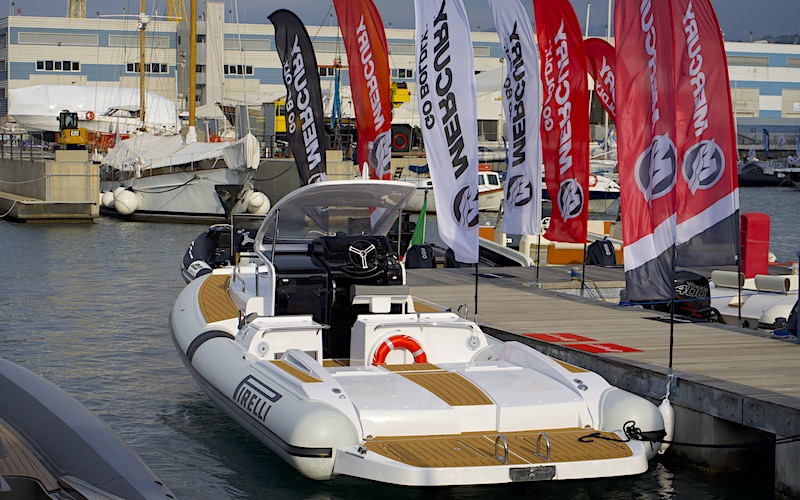 The boat chosen by Mercury Marine to carry out our test is a really extraordinary boat. With an overall length of 11 meters and a displacement of 3 tons, the Pirelli 1100 Cabin is the ideal vessel where to test new engines. Available in variants of up to 700hp, the boat features the lowest engine option available, which represents an additional reason to see how the two Mercury Diesel 3.0 L 270hp engines installed on board will act at sea.
The day is perfect to carry out such an interesting test; at night, indeed, the sirocco made the sea rough and we can therefore enjoy the ideal conditions to test the new engines.
We cast off and, with the help of the Piloting Joystick, we leave the basin that hosts the 58th Genoa International Boat Show. Out of the port, we are immediately greeted by an annoying wave of almost 2 meters that, in addition to making our test interesting, complicates the preparing operations of the Millevele, the regatta that paints the sea with the white colour of hundreds of sails today.
At idling speed, the two engines are  barely perceptible and I order the other passengers to find a safe place on board since what awaits us is not certainly a comfortable Sunday cruise. Since we are expected to “dance”a lot, I put the controls in the “single lever” mode and, gently, I start to accelerate in order to test both speed and fuel consumption.
The Pirelli advances with no problems and this comforts me a lot; the bow cuts through the waves and the boat doesn’t slow down so much before the impact against water masses. At 1,200 rpm, we travel at 9-10 knots, which is the speed that usually troubles the boats sailing with a high bow before gliding on water. But this is not our case, partly because the Pirelli 1100 Cabin is already well-trimmed, partly because the two engines on the stern are really light. Anyway, we sail well, with the bow relatively low.
I go on accelerating and the boat starts gliding while the Mercury Diesel start to deliver its sound. At little more than 2,000 rpms, we travel at 20 knots, with a perfect wake and a fuel consumption of less than 30 l/h.
Equally noteworthy is the performance delivered by the boat that, at this speed and under these sea conditions, keeps on sailing stable and safe. I sail far from the trajectory of the other sailboats and I try to put throttles down: the two engines roar and we are literally catapulted forward.
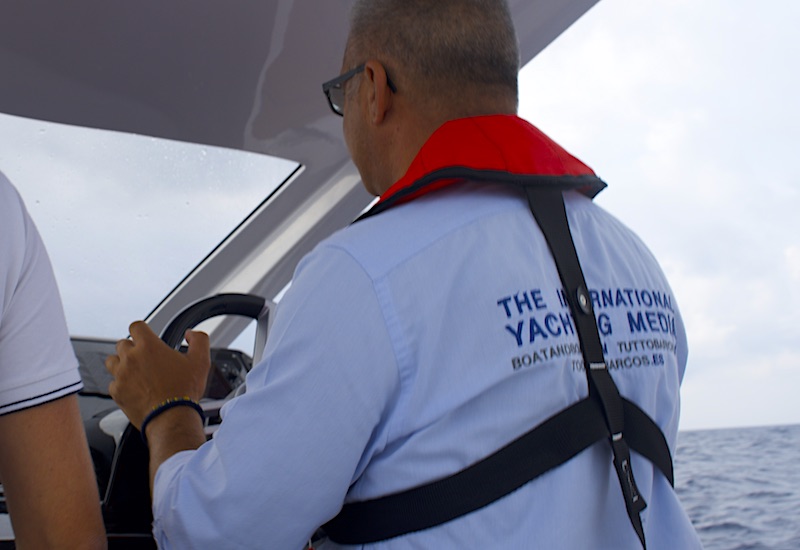 Acceleration is great, the torque is exciting. At 34 knots, I take my foot off the gas because, under these sea conditions, we cannot go beyond. The Pirelli jumps from one crest to another and, when she finally touches down, two huge white bow waves frame the tubes. At this speed ( and under these conditions) we’re using about 70 liters per hour: a really astonishing performance!
I stop and take my chronometer, I reset it and put throttles down. The turbocharger takes just a few seconds to be fully operative, then we have to be careful since acceleration is simply brutal. Speed goes from 0 to 30 knots within little more than 7 seconds: really surprising, especially if we consider sea conditions and the fact that this is the lowest engine option available. Torque is overabundant.
At 20 knots, I zigzag in the waves and I try to “follow” the sea by accelerating and decelerating. This is the real task that these engines should carry out when things go bad at sea: you have to accelerate until the crest, take your foot off the gas, get down the cavity of the wave and speed up again. The new Mercury Diesel engines carry out this task effortlessly, with no hesitation. They’re simply perfect!
I perform some  tight turns and, at about 20-22 knots, the Pirelli is surprisingly seaworthy. I accelerate and slow down but, both the RIB and the two Mercury Diesel, show no sign of trouble.
I turn around and I look at the faces of the other passengers. Everyone seems to say something halfway between “that’s cool” and ” stop it, please!” so, a little reluctantly, I give the controls to my colleague who, more wisely than me, avoids further maneuvers and takes us to the port, sailing in waves at 15-18 knots.
Despite these conditions, the Pirelli 1100 Cabin and the two Mercury Diesel 3.0 L give us an excellent sailing comfort. Finally, the inner breakwater welcomes us and our “jumping” movement gives way to the quieter gait of the RIB in calm waters.
The bow cuts through the flat water at 5 knots while the two engines whisper silently and take us to the berth. Adrenaline decreases and I realize that I have just tested two exceptional engines.
| Total Engine Consumption | ||||
| Rpms | Speed in knots | l/h | l/nm | |
| 650 | 4.6 | 2.6 | 0.6 | |
| 1,000 | 7.3 | 6.,4 | 0.9 | |
| 1,200 | 9 | 9.7 | 1.1 | |
| 1,400 | 10.2 | 15.6 | 1.5 | |
| 1,600 | 12.4 | 18.2 | 1.5 | Minimum planing speed |
| 1,800 | 14.1 | 24 | 1.7 | |
| 2,000 | 17.9 | 27.1 | 1.5 | |
| 2,200 | 20 | 35.5 | 1.8 | |
| 2,400 | 21.8 | 39 | 1.8 | |
| 2,600 | 24.7 | 47.3 | 1.9 | |
| 2,800 | 28.7 | 54 | 1.9 | |
| 3,000 | 31 | 61 | 2.0 | |
| 3,200 | 34.1 | 72 | 2.1 | |
| Acceleration | |
| from 0 to 10 knots | 2.13 seconds |
| from 0 to 20 knots | 4.35 seconds |
| from 0 to 30 knots | 7.21 seconds |
Mercury Diesel 3.0L – Technical Specs
| Power mhp / kW | 270 |
| Bore and stroke | 3.27 x 6.62″ / 83 x 92 mm |
| Maximum RPM (WOT) | 4200 |
| Engine type | V-6 |
| Displacement | 3.0L |
| Dry Weight (engine only) | 358 Kg (789 lbs) |
| Dimensions (L x P x A) | 36.7 x 33.4 x 32.0″ / 847 x 849 x 813 mm |
| Peak Torque | 594 Nm @ 2200 rpm |
| Air Handling | Turbocharged and Aftercooled |
| Fuel System | High pressure common rail |
| Rotation | Counter clockwise facing flywheel |
| Compression Ratio | 16.5:1 |
| Fuel Pre-filtration requirement | Not required |
| Fuel lift pump | On engine |
| High pressure fuel pump | Bosch CP 4.2 w/ integrated gear lift pump |
| Valves per Cylinder | 4 |
| Pistons | Oil jet cooled |
| Fuel injectors | Bosch CRS 2.20 (Solenoid) |
| Glow Plugs | Standard equipment with Bosch glow plug control unit (GCU) |
| Air inlet (Starboard Rear) | Filtered and silenced |
| Turbocharger | Honeywell VGT |
| Engine and turbocharger cooling | Closed cooled |
| Coolers | Aftercooler, Engine Coolant, Engine Oil, Power Steering / Gear Oil and Fuel – All are tube and shell |
| Seawater pump inlet size | 38 mm (1.5 in) |
| Oil sump volume | 8.5 L |
| Dipstick range | 1.0 L |
| Oil maintenance interval | 200 hours or annually |
| Coolant Volume | 12 L |
| Flywheel size | 290 mm (11.42 in) SAE 8 |
| Electrical system | 12 V, 110 A w/ conveniently located battery power and ground studs |
| MerCathode (Sterndrive only) | Engine mounted |
| Engine Stop | ECU Controlled |
| Engine Control Unit (ECU) | Bosch EDC17 |
| Sensors | Crank & cam position, intake manifold pressure/temp, compressor outlet temp, coolant temp, seawater pressure/temp, |
| atmospheric pressure, exhaust gas temp, fuel temp, rail pressure, water in fuel (WIF), oil pressure/temp | |
| Throttle and shift | Mercury DTS or Mechanical Cable |
| Helm and gauge compatibility | Mercury SmartCraft |
| Mercury Joystick Piloting | Compatible with Joystick Piloting for Sterndrives (Axius) |
| Sterndrive: Mercury Bravo One X | 1.36, 1.5, 1.65 |
| Sterndrive: Mercury Bravo One X SeaCore | 1.36, 1.50, 1.65 |
| Sterndrive: Mercury Bravo One XR | 1.35, 1.50 |
| Sterndrive: Mercury Bravo Two X | 1.50, 1.65, 1.81, 2.00 |
| Sterndrive: Mercury Bravo Two X SeaCore | 1.50, 1.65, 1.81, 2.00 |
| Sterndrive: Mercury Bravo Two XR | 1.65 |
| Sterndrive: Mercury Bravo Three X | 1.36, 1.50, 1.65, 1.81, 2.00 |
| Sterndrive: Mercury Bravo Three X SeaCore | 1.36, 1.50, 1.65, 1.81, 2.00 |
| Sterndrive: Mercury Bravo Three XR | 1.65, 1.81, 2.00 |
| Sterndrive: Mercury Bravo Three XR SeaCore | 1.65, 1.81 |