
How does the Aquila 50 Sail perform? The complete sea trial
It is early morning when I arrive at the Pier Sixty-Six Marina in Fort Lauderdale; the crisp morning air and the total absence of clouds already suggest it will be a beautiful day—an adjective that for us sailors, unfortunately, also means there will be little wind. A condition where cruising sailing catamarans normally suffer quite a bit (to use a euphemism).
I turn the corner of a pier and spot the Aquila 50 Sail waiting for us, moored alongside. At first glance, I am immediately struck by its sinuous profile; this catamaran has a silhouette light years away from the cubiform (and horrible) ones the market has accustomed us to.
I step on board and immediately begin to analyze the hybrid propulsion system, one of the innovations introduced by this cat. Powering us today are two 40 kW electric motors each, fed by an 80 kWh battery. A system produced by Torqeedo that guarantees us, on paper, about 40 nautical miles of range before having to start the 40 kW onboard generator which, in addition to providing charging power, also allows for the operation of air conditioning, induction plates, and all onboard systems.
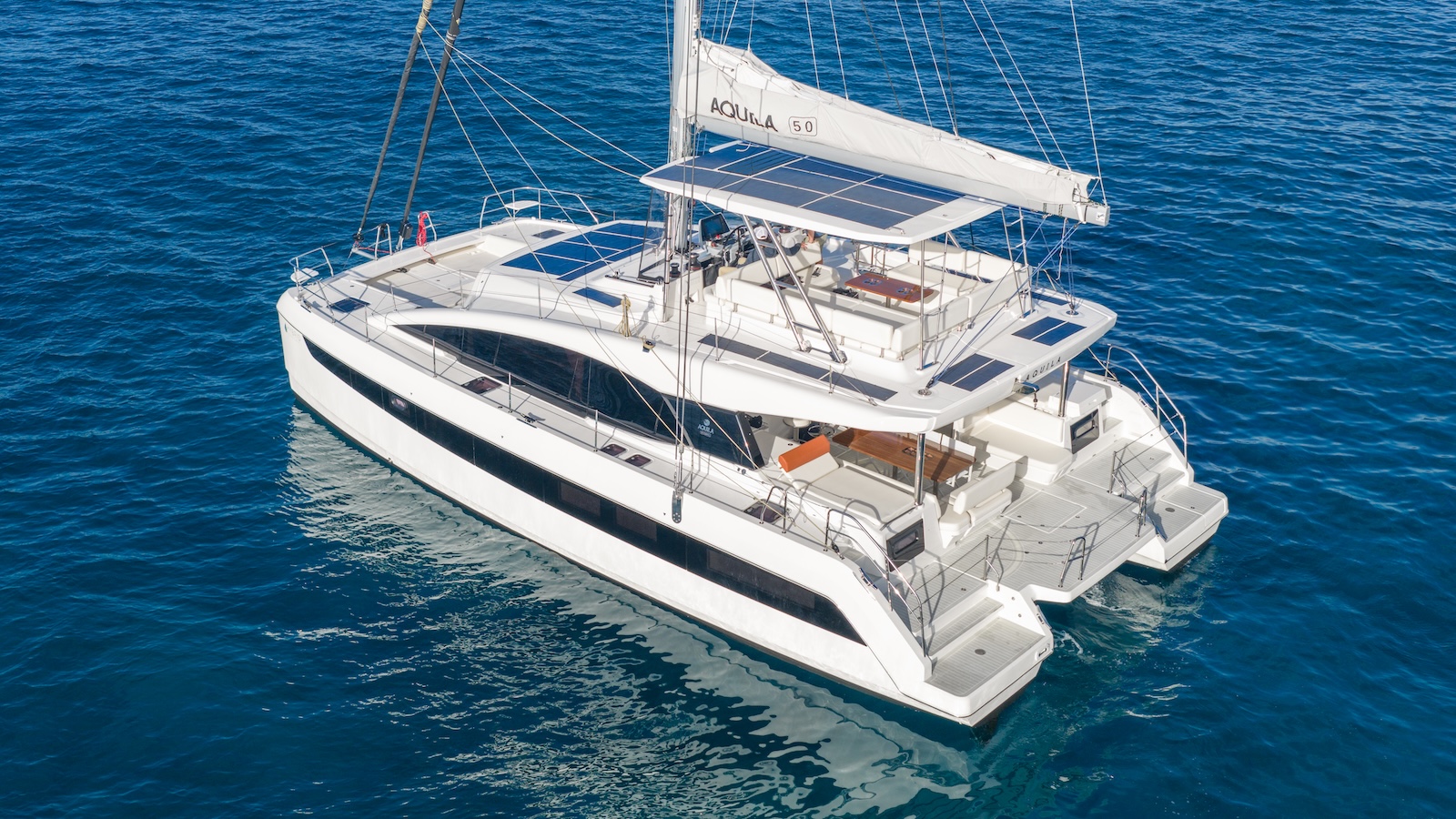
The sail plan of this Aquila 50 Sail is decidedly well-structured; one can choose between a traditional mainsail and a square top—the one we have available today, measuring a full 96.4 square meters. A choice I agree with because the nearly seven extra square meters of canvas are at the top, exactly where they perform best. The genoa is slightly overlapping, measuring 66 square meters, bringing the upwind sail area to a total of 162.4 square meters. Completing the set is a 103-square-meter furling Code 0 which, I am sure, we will certainly use today.
We cast off and move away from the dock using the maneuvering thrusters and the engine throttles; maneuvering the Aquila 50 Sail is truly simple with all these aids. From the flybridge, visibility is perfect; the bows are clearly visible, and assessing the dimensions of this large catamaran is really not a problem.
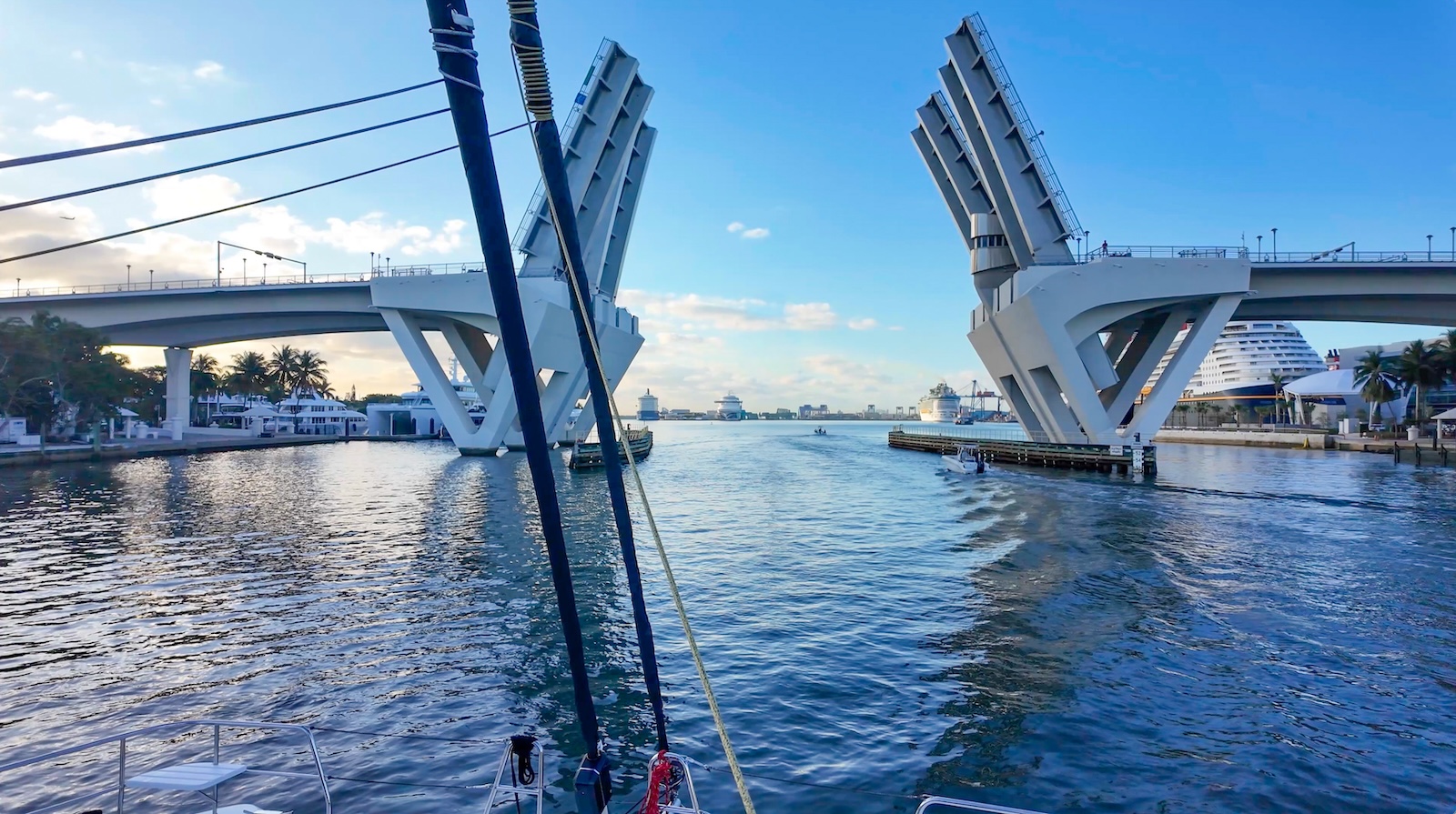
We proceed under power along the canal leading to the ocean; at 6 knots, the consumption in kW is just over 10 kWh, which means we could sail for nearly 50 miles without having to start the generator. It also means that if we did start it, we would not only support the batteries but could even recharge them—a decidedly interesting energy balance! Furthermore, electric propulsion is inherently very similar to sailing; there is absolute silence, with only the sound of waves lapping against the hulls.
Sailing performance of the Aquila 50 Sail: surprising in light winds
Arriving in the ocean, we find a long swell just under a meter high and a true wind of about 6 knots—difficult conditions for a cruising cat…
We hoist the mainsail quickly—with the electric winches it’s child’s play—and then open the furling genoa. All maneuvers are led to the port and starboard of the helm station, and managing this sailing catamaran alone is not only simple but also decidedly comfortable and safe.
I bear away and set Aquila 50 Sail at approximately 50 degrees from the apparent wind. Under these conditions I expect speeds close to zero, but instead the cat progressively accelerates and begins to generate apparent wind, and soon we are doing over 4 knots, 4.4 to be precise. I try to head up and, once again, Aquila 50 Sail surprises me, managing to sail at 35 degrees to the apparent wind, losing only two-tenths of a knot!
A decidedly extraordinary performance for a cruising cat that, moreover, is not equipped with daggerboards.
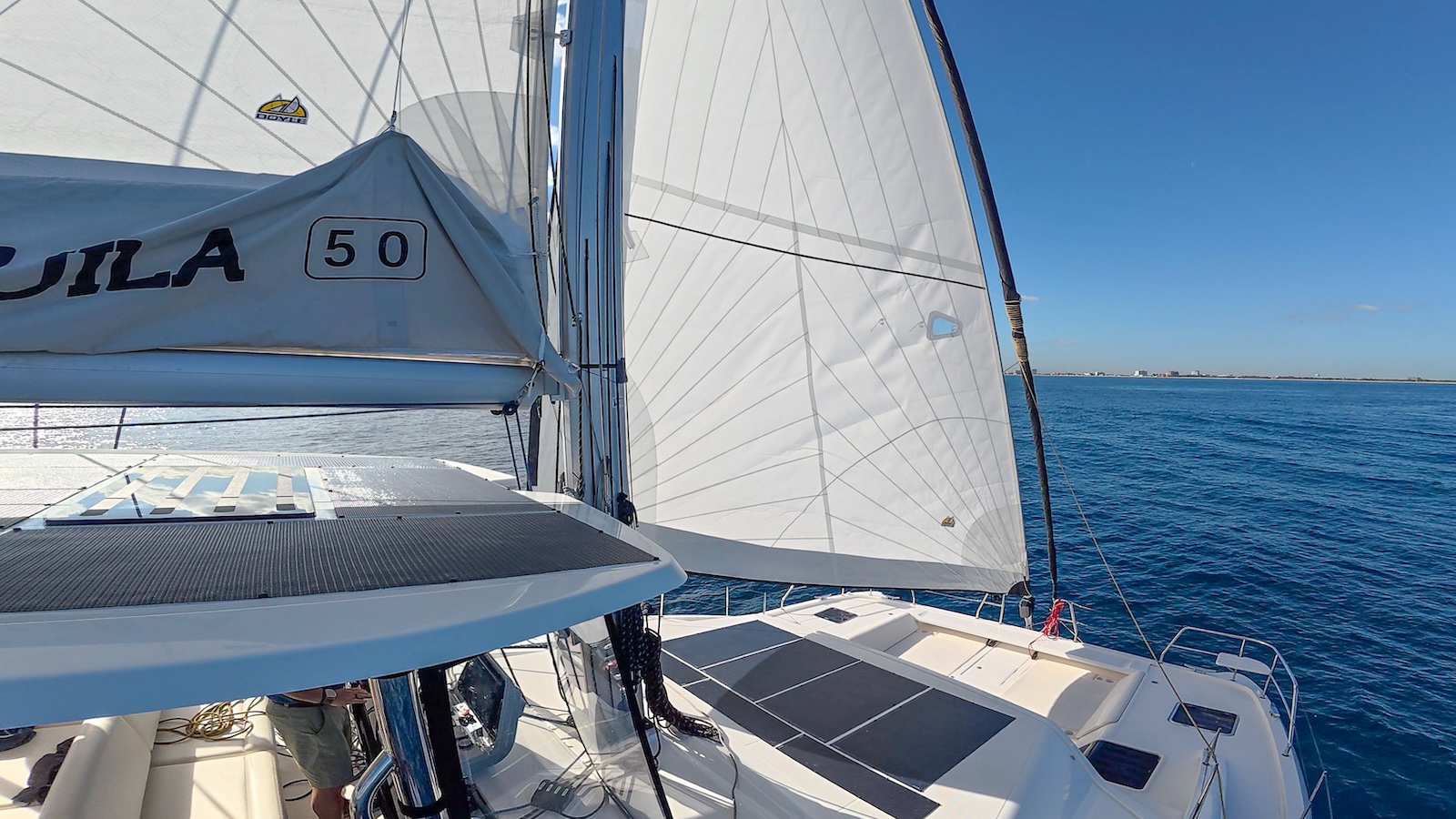
Enthusiastic, I ask to close the genoa and open the Code 0, an operation that is again managed with great simplicity since the sheets for this sail are also led near the helm. This boat is truly manageable by a single person.
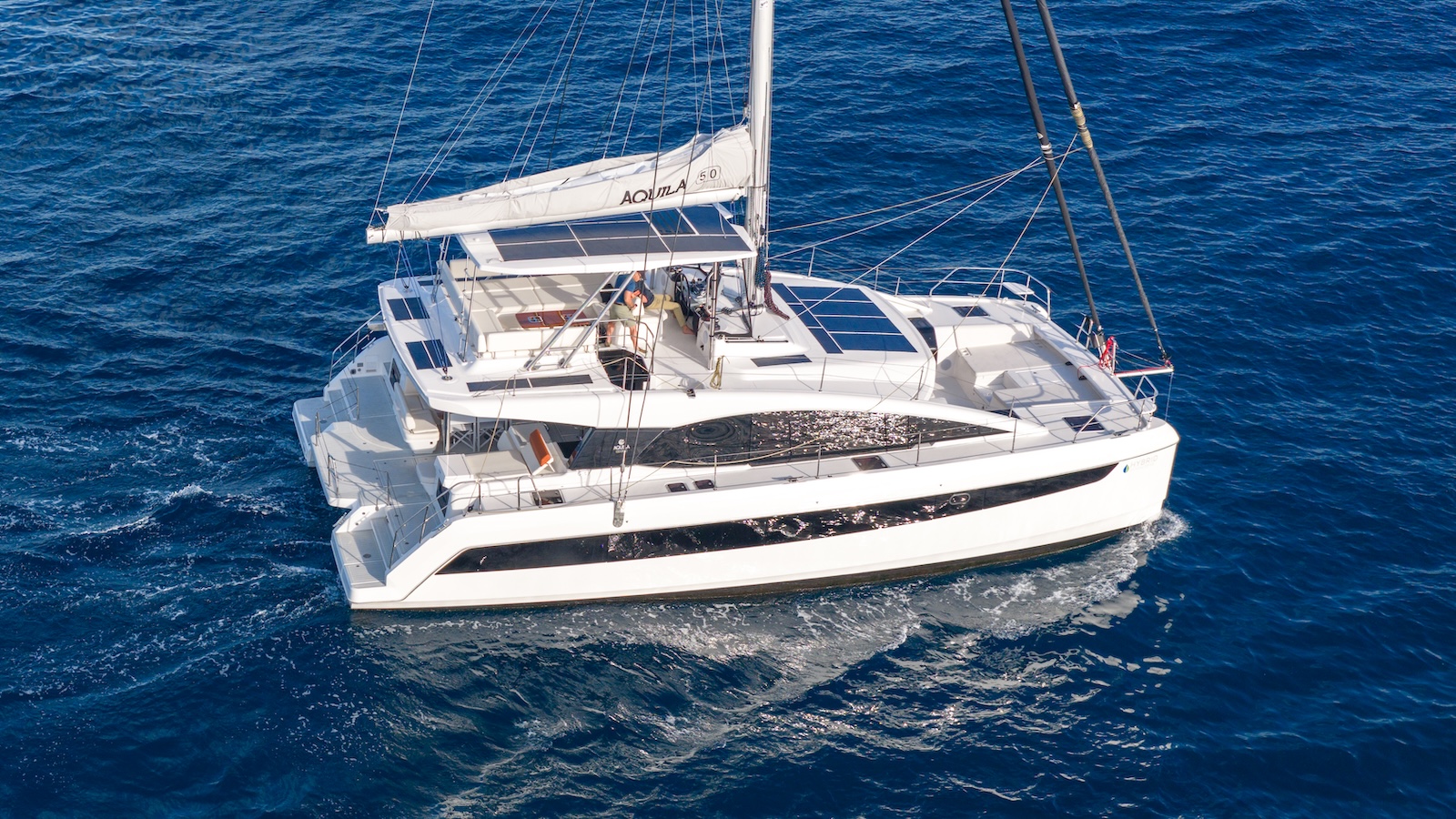
I bear away a bit more and at 90 degrees from the apparent wind I fine-tune the mainsail and Code 0, Aquila 50 Sail accelerates immediately and reaches 5.5 knots. I head up to 50/55 degrees from the apparent wind, ease the Code 0 slightly and the cat accelerates noticeably again, in an instant we pass 6 knots and record a maximum speed of 6.2 knots!
We are on a cruising cat and we are sailing at a speed higher than the true wind, which, still very weak, fluctuates between 5 and 6 knots.
This Aquila 50 Sail is a true revelation; I can only imagine what performance it could offer in medium wind conditions or with more high-tech sails.
The set of sails we have available today, while tri-radial and well-made, is certainly not a high-performance set, and this adds even more value to the recorded data.
Aquila 50 Sail under electric power: speed, consumption, and range
Needless to say, shortly thereafter the wind dies completely and we have to furl the Code 0. We still have quite a few miles to cover to arrive in time at Miami, where Aquila 50 Sail will be displayed at the boat show of the same name.
We engage the throttles and the two electric motors begin to push us silently forward. At 7 knots, we sail consuming only 22 kW; at 7.5, we consume 28; and at 8 knots, we are still under 40. This means we can sail at cruising speed, keeping the generator on, for an indefinite time while consuming very little fuel.
Curious, I push the throttles all the way and quickly reach 9.2 knots—a very respectable top speed for this Aquila 50 Sail in its hybrid version.
Optionally, one can of course choose a traditional version, where a pair of diesel saildrive inboards can push this cat to even higher speeds, although, in my opinion, this hybrid version is perfectly balanced and already provides everything needed to sail in the best possible way. The 80 kWh battery and the 40 kW onboard generator also perform many other functions, useful for living in complete comfort without the worry of energy consumption.
In summary, a high-level cruising catamaran that I would personally choose in exactly this configuration, not only for summer cruises but also for setting off on a long world tour.
Below are the data recorded during the remainder of the test, which highlight how excellent range can be achieved even without starting the generator. The data were recorded while sailing with six people on board, in slight sea conditions, with water and fuel tanks at 100%.
Design, interiors, and innovations of the Aquila 50 Sail
To fully understand the scope of the innovations that the new Aquila 50 Sail brings, one must necessarily stop for a second and list them; there are truly many.
The design: why the Aquila 50 Sail looks like no other catamaran
The design of this sailing vessel deserves the first mention. Light years away from what cruising-oriented sailing catamarans have accustomed us to, it manages to simultaneously accommodate volumes significantly higher than those of its direct competitors and offer light, sinuous, and sporty lines. A result that was by no means guaranteed.

The stern and the beach club: an innovative solution
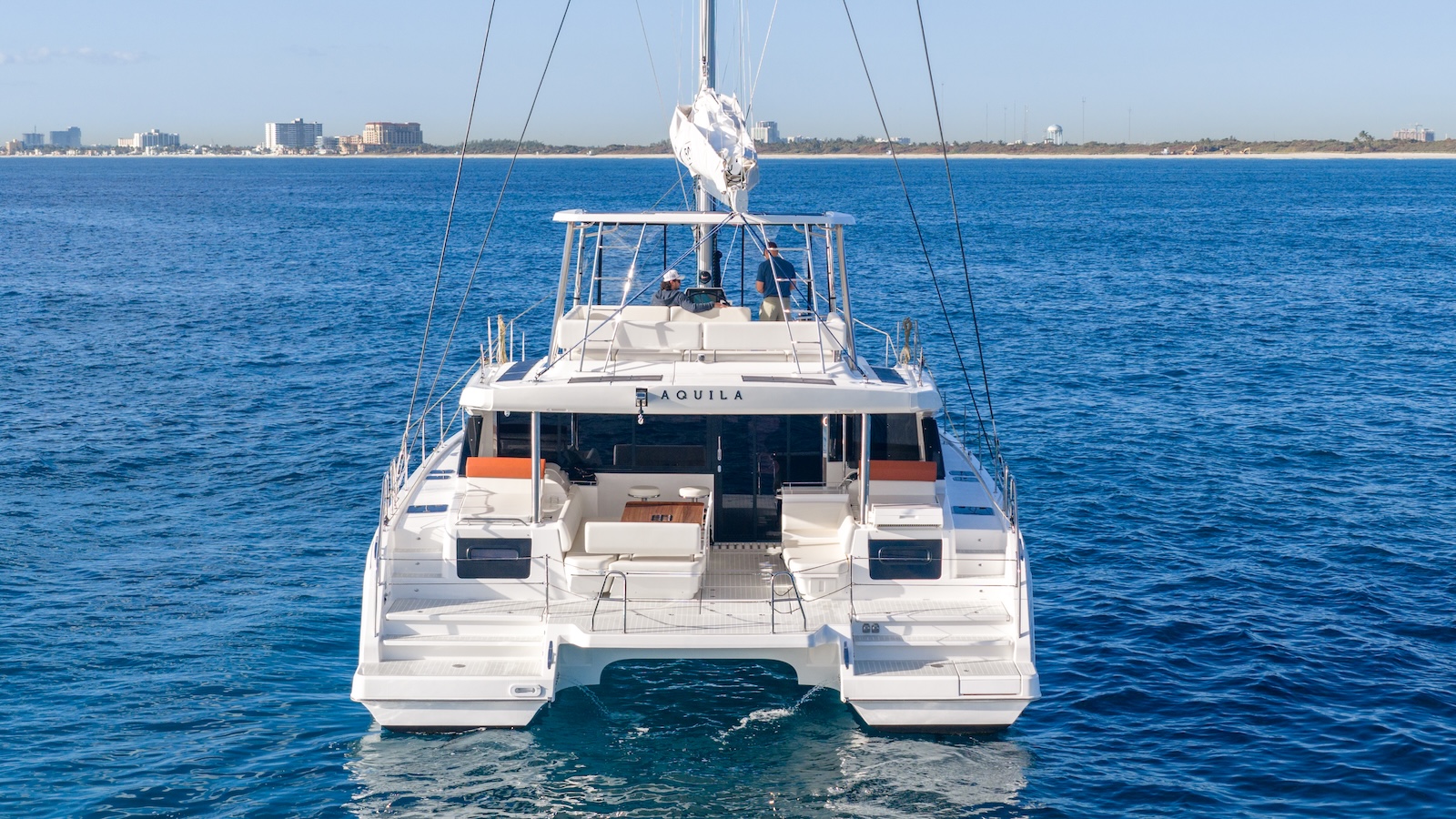
The stern of the Aquila 50 Sail contains two important innovations: the first is represented by the width of the ends of the two hulls which, being much wider than anything seen before on a sailing catamaran, offer the concrete possibility of being used as a beach club.
The second innovation is the stern platform which, served by a winch, allows for the launching and storage of a large tender, resting on a system of movable cradles that ensures stability while sailing. This area is also transformable; it is possible to move the stanchions and lifelines that delimit it forward or backward to adapt it to the presence or absence of the tender.
The synthesis of these two innovations allows, on the one hand, to avoid the adoption of a heavy hydraulic platform, and on the other, effectively creates a single massive beach club from which to enjoy stops at anchor.
The Flybridge: accessible from the bow, an absolute first
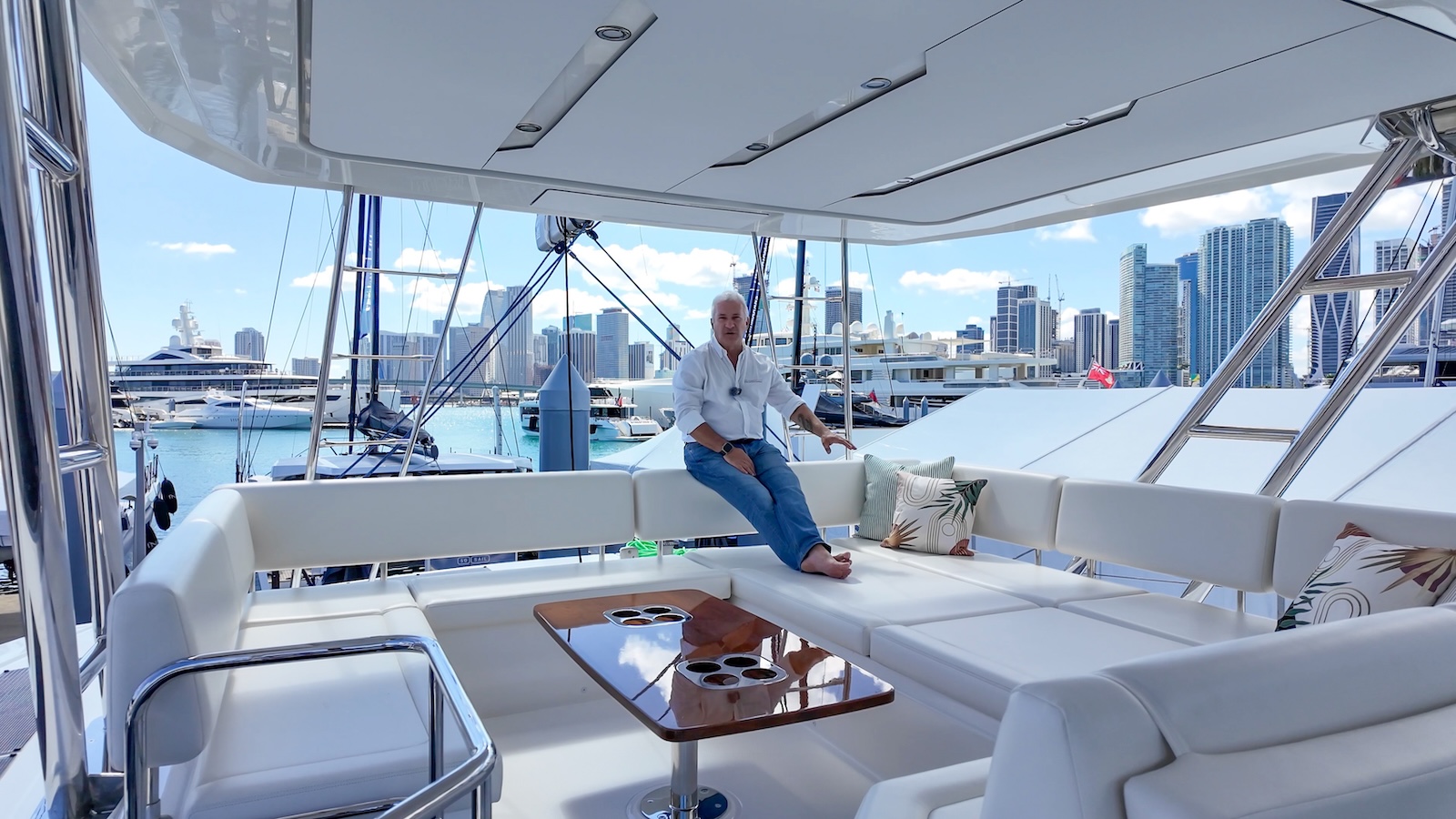
The Flybridge of the Aquila 50 Sail is enormous but perfectly integrated into the sporty lines of this sailing catamaran—a truly remarkable result that synthesizes the shipyard’s extensive experience with power catamarans. The great innovation this cat introduces is that it can be reached both from the usual staircase starting from the aft dinette and from the two sloping side decks connecting it to the bow.
An innovative system that simplifies onboard circulation and makes all maneuvers easier, including mooring and anchoring, but that’s not all. Indeed, if you look at the Aquila 50 Sail from the side, you will notice how the Flybridge develops continuously from the foredeck; this effectively creates a monolithic structure that provides great structural rigidity, clearly perceptible while sailing.
The Flybridge Hard-Top is walkable and served by two access ladders—a very simple system for safely managing the opening and closing of the Lazy Bag.
The cabins of the Aquila 50 Sail: from 4 to 6, all with private bathrooms
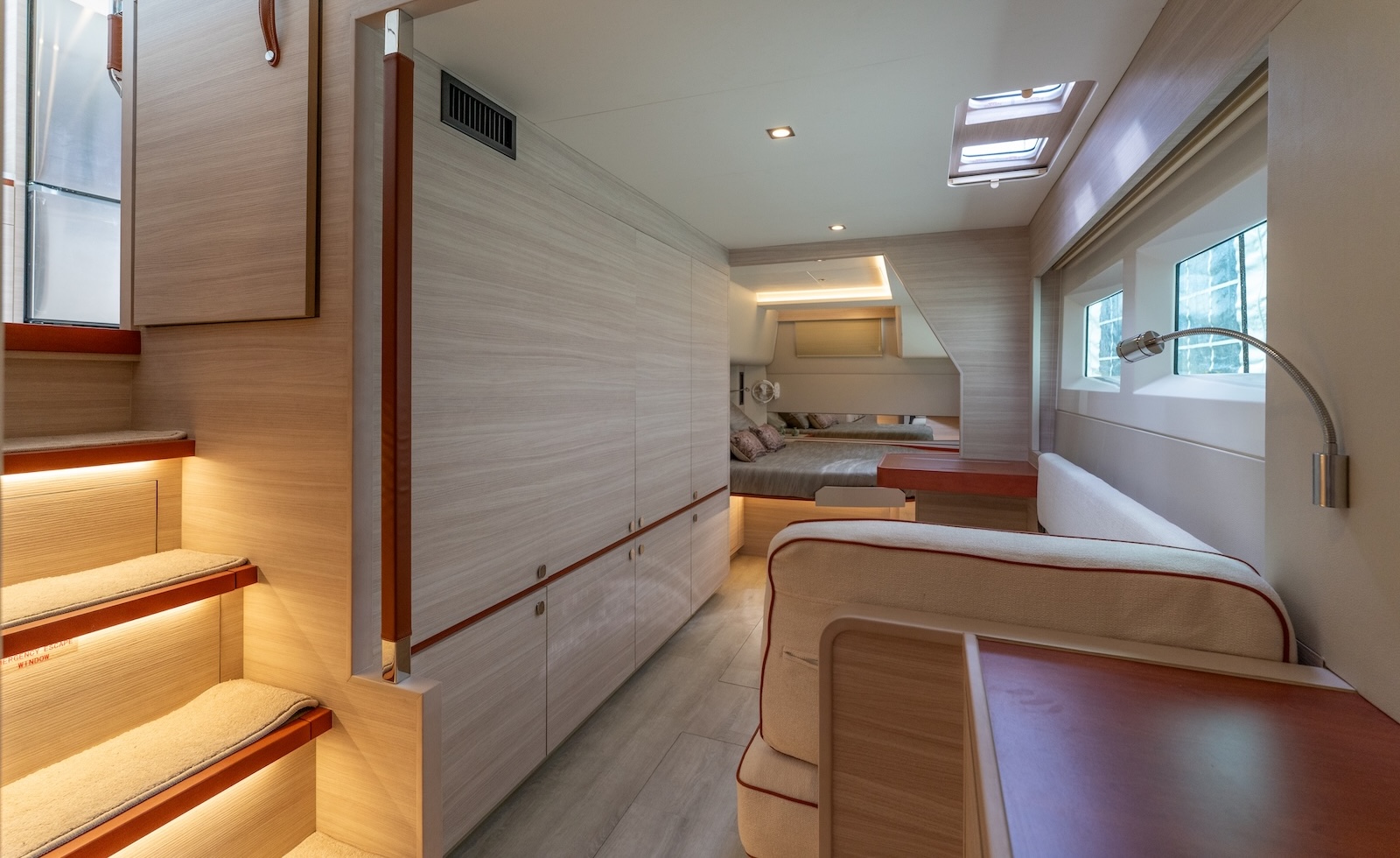
The engineering of the interior spaces of the Aquila 50 Sail is decidedly extraordinary and makes this 50-foot cat unique in its class. It is indeed possible to customize the layout to your liking, starting from the 4-cabin version, the most exquisitely owner-oriented, up to the charter version, which boasts a full 6 cabins and 6 bathrooms!
But the surprises do not end there because, very intelligently, every cabin is equipped with private access and a bathroom with a separate shower box, even in the 6-cabin version. A feature that enhances guest privacy and makes life on board decidedly simple.
The final important innovation is the possibility of purchasing the 6-cabin version and being able, perhaps after a period dedicated to chartering, to return to the 4-cabin version with a simple and non-invasive conversion.
Is the Aquila 50 Sail worth buying? The final verdict
This new Aquila 50 Sail has decidedly won us over. It is an innovative sailing catamaran that manages to be simultaneously fast and spacious, beautiful and very practical. Furthermore, characterized by a starting price of less than one million dollars, or less than 850,000 euros, it is decidedly interesting and probably represents the best current choice in terms of value for money.
