

Welcome to Boat Review’s Sailing Catamaran Test Section
Welcome to the BOAT REVIEW section dedicated to sailing catamaran tests.
Our testers will take you straight on board through videos and engaging reports that combine technical analysis and pure sensation, guiding you among hulls, cockpits and sails as if you were at the helm yourself. All our sailing catamaran tests are designed to let you feel the true character of each boat: from the first impression in the marina to the final mooring, passing through downwind runs and close-hauled sailing. You’ll discover how the wind fills the mainsail and the genoa, how the hulls slice through the waves with precision and stability, and how every manoeuvre—from a gybe to winch trimming—becomes an experience that blends safety, performance and the sheer pleasure of sailing.
The aim of this BOAT REVIEW section is not just to describe the most appealing proposals from shipyards around the world, but to help you understand what it really means to live the sea aboard a modern sailing catamaran. Our analysis always starts from the hulls and moves all the way up to the flybridge, including a detailed look at rudders, foils and propulsion systems, whether diesel, hybrid or electric. Terms such as rigging, forestay, boom, shrouds and halyards will become easy and familiar, because they are tested in real operating conditions, assessing their precision, efficiency and response under sail. Each test thus becomes a practical lesson in sailing and naval engineering, allowing readers to understand how design choices truly affect performance and comfort.
Sailing Catamaran Tests: a 306-degree walkthrough
During our sailing catamaran tests, we analyze how the hulls behave on a beam reach, how waves influence roll, and how wind pressure on the sails translates into speed and stability. Ample space is also devoted to evaluating key technical parameters such as lift, drag, leeway angle, hull trim and longitudinal balance. Every detail, from bulkhead construction to carbon reinforcements, is examined closely by our journalists to provide the most complete and accurate picture possible of each model.
Thanks to our sailing catamaran tests, readers and viewers can virtually inspect every corner of the boat, as if they were physically on board. From winch layout to rope runs, from rudder positioning to access to manoeuvres, everything is carefully analyzed to understand how functional, safe and comfortable the boat is at sea. We assess how easy it is to handle sheets and halyards, the strategic placement of control panels and electronic displays, as well as the layout of engine controls and auxiliary systems. Every detail, from the protection offered by the hardtop or sprayhood to freedom of movement between seating areas, is observed in practical, real-world situations and in a wide range of sea conditions.
Our sailing catamaran tests also analyze the layout of technical spaces, access to tanks and hydraulic and electrical systems, weight distribution and the practicality of storage areas. The central saloon, compact yet functional galleys, owner’s cabins, guest and crew areas with private bathrooms and separate showers are all described not only from an aesthetic point of view, but also in functional terms, helping readers clearly and effectively navigate the potential choice of their dream catamaran.
Sea Trials
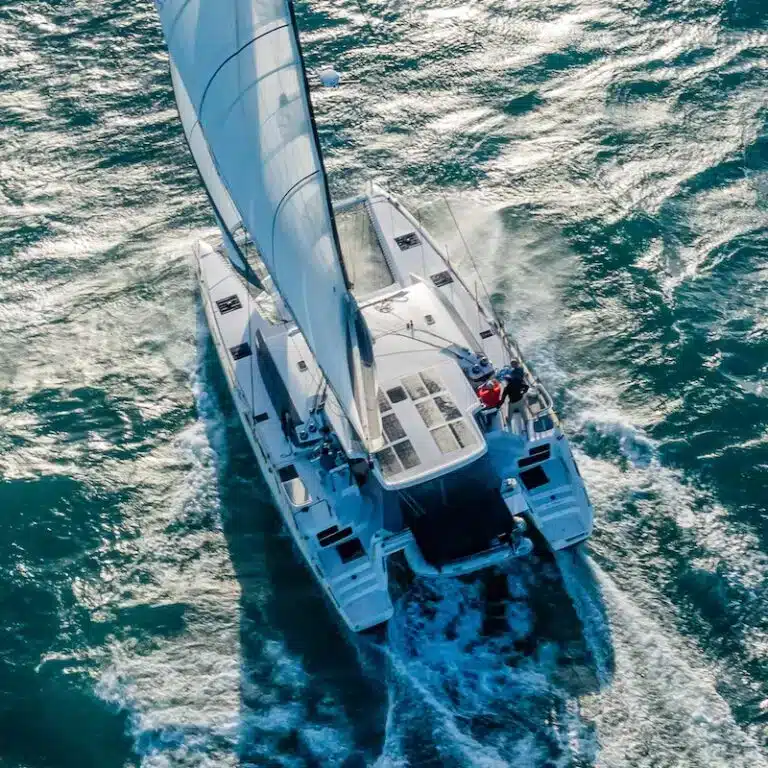
At sea, our sailing catamaran tests are the perfect opportunity to carefully and precisely analyse the behaviour of the sail plan in its various configurations, observing the performance of the mainsail, furling genoa, Code Zero and asymmetric spinnaker according to wind strength and direction. BOAT REVIEW testers carefully evaluate catamaran behaviour across different points of sail—from close-hauled to beam reach, through to broad reach and running—checking the effectiveness of fine tuning, mast trim and the loads applied to halyards and sheets. We monitor average and top speeds in relation to apparent and true wind, effective upwind angles, stability during acceleration and the boat’s immediate response to trim changes, especially during transitions between points of sail and manoeuvres.
Without overlooking fundamental elements such as the vang, mainsheet traveller, lead blocks, winches, purchase systems and the quality of both running and standing rigging, we delve into every detail that affects the overall efficiency of the rig. The goal is not to offer a simple technical description, but a deep and comprehensive sea trial in which every sensation at the helm, every reaction of the hulls to the waves and every manoeuvre performed—from tacking to gybing—becomes an integral part of a thorough and rigorous evaluation.
And precisely in order to provide the most realistic and complete picture possible of each catamaran, we at BOAT REVIEW never shy away from even the most challenging sea conditions.
Our sailing catamaran tests are therefore also carried out in rough seas, with variable winds and demanding currents, as these often represent the best opportunity for our testers to analyze rudder and propeller responsiveness, boat behaviour in leeway, and the actual weight distribution with reduced crew or full load. Without, of course, neglecting the “emotional” side of the test: the thrill of pushing limits, steep waves and surprising landings, the wind rushing between the hulls when sailing upwind, and the exhilaration of the most demanding gybes.
Sailing Catamaran Tests: between materials and comparisons
Another extremely important aspect is materials. During our sailing catamaran tests, we analyze advanced composite materials, sandwich hulls with Corecell or balsa cores, carbon reinforcements on bulkheads and stringers, hybrid or electric propulsion systems, integrated solar panels and intelligent energy management, always keeping a close eye on the latest innovations in sustainability.
Finally, our sailing catamaran tests offer an excellent starting point for comparing the different models proposed by shipyards, highlighting strengths, limitations and distinctive design features, helping owners and enthusiasts alike to make more informed choices when selecting the boat best suited to their sailing needs.